





Author: Eric H. & Alex R.
Originally published: Spring 2021
Updated: Spring 2026
All the ropes in this review will perform beyond your expectations, which is why we selected them to be part of our collection. This review looks at the nuances between a range of climbing ropes, from pure performance lines suited for redpoint attempts or light-and-fast alpine objectives to thicker workhorses built for projecting, hangdogging, and top-roping.
The ropes reviewed here include a mix of single, half/double, and twin-rated ropes, with some also carrying triple ratings. The symbols shown below are used internationally to indicate a rope’s certification and intended use.
If you want to learn more about the standards a rope must meet to receive these ratings, check out the UIAA Safety Standards.
Note: Climb On Equipment, selects products based on the expertise of our team. We comprise of climbers, athletes, guides, skiers and mountain rescuers. We then take the selected products and compare them in this independent review to help consumers make educated purchases. We are not paid for these reviews. This means that if we don't like a product feature or vice-versa, we will tell you!
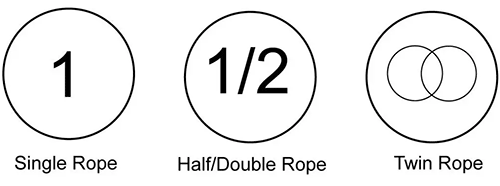
Single, Half and Twin Ropes
Single ropes remain the most popular choice for rock climbing and are the system used by most climbers. Half and twin ropes are more commonly used for alpine rock and ice climbing, where two ropes are carried instead of one.
Half ropes (also known as double ropes) and twin ropes use different belay techniques. Half ropes are clipped independently to different pieces of protection, while twin ropes are clipped together as a pair. If you would like a more detailed explanation of these systems, see our Climbing Rope Guide.
Advantages:
- Both half and twin rope systems allow for full-length rappels, reducing the number of rappels required on long routes.
- Half ropes can reduce rope drag on wandering pitches.
- Half ropes lower the impact force transmitted to protection placements when used correctly.
Disadvantages:
- Both systems require managing two ropes instead of one.
- Half rope technique has a steeper learning curve than twin rope technique, particularly when belaying.
Some ropes are triple rated, meaning they can be used as a single, half, or twin rope depending on the objective.
When choosing a climbing rope the key considerations are:
Handling and Feel
A rope needs to be soft enough to clip easily into a quickdraw or be pulled through a belay device, but not so soft it coils and loops making handling difficult. The weave on the sheath — the sheath thickness and finish on a rope — will contribute to how a rope handles. Finding a balance between all the factors takes years to develop and production skills in the factory. Handling is often noticed more by a belayer who is attentively giving and taking slack during a day of sport climbing.
Diameter (mm)
The diameter of a rope plays a huge role in its handling. A fat 10 mm rope is "sticky" in a newer GriGri but a skinny 8.9 mm rope used with an ATC requires a very attentive belayer. Rope manufacturers have improved rope technologies and rope diameters have been gradually reducing, as have belay devices to match the new norm of rope diameter. The balance between a skinny and light rope that is also durable and catches softly is a never ending quest for manufacturers. For all-around rock climbing, a rope between 9.4 mm and 9.6 mm is considered the norm. However, single-rated ropes are now available down to 8.5 mm.
Durability
Paying for a cheap rope may at first seem like a good idea. But, after a half dozen falls it starts to breakdown, flatten, swell or even open up. You will need to replace it sooner and be back at our store to pay for another rope. A good quality climbing rope should be able to handle multiple falls over a season and, if you avoid sharp edges, can last many seasons. The longevity of a rope is often shortened by misuse rather than just normal use. One sharp edge or a gouged out carabiner can damage a rope after one fall; expect a rope to take use not abuse. Keep your rope clean and away from chemicals, out of direct sunlight and stored in a cool dry spot.
Weight (Grams per Meter - g/m)
The lighter a rope the less weight you are carrying to the crag and the less weight you have to drag up a route. If you find yourself counting saved grams of weight in your harness, draws and diet, then picking a lighter rope will be of importance.
Features
Ropes come with a variety of additional safety features that benefit the climber.
- Mid-marker. The rope is marked with a black mark at half way.
- Bi-Colour. The rope is two different colours, the colour changes at half way.
- End warning markers. Some ropes come with markers to indicate the end of a rope.
- Length (m). Select a rope most suited to the area you are using it. Most routes in Squamish can be climbed with 60m rope, However you might need a 70m, 80m or more in other destinations.
- Pre flaked rope. A rope that comes directly off the spool during manufacturing will need to be flaked at home before use. Some manufacturers do this for you so can climb immediately.
Dry Treatment
Ropes can be treated to reduce water absorption. In addition to helping keep a rope drier in wet conditions, dry treatments also help reduce the amount of dirt and grit absorbed into the rope over time, which can prolong its lifespan.
Throughout this article, any rope we refer to as “dry treated” meets the UIAA Water Repellent standard. To receive this certification, a rope must absorb less than 5% of its weight in water during standardized UIAA testing. For comparison, a non-treated rope can absorb around 50% of its weight in water during the same test, while ropes marketed as “dry” but lacking a full UIAA-certified treatment may still absorb between 20% and 40%.
Some ropes on the market may feature partial dry treatments, such as a dry-treated core only, without meeting the full UIAA Water Repellent standard.
Price ($CDN)
Everyone loves a good deal and rope prices are creeping upwards. The price of a rope generally increases with the addition of features, length, treatments and technologies. We would advise selecting a rope that is fit for purpose with the features that keep you safe. While all the single rated ropes will complete the job of catching falls safely, a carefully selected rope may help you complete your red point list quicker this summer.
Other Considerations
- Static Elongation (%) - How much a rope stretches under a static 80kg load.
- Dynamic Elongation (%) - Dynamic elongation is the amount of rope stretch produced by the standard dynamic test, performed in a drop tower..
- Sheath Proportion (%) - The ratio of sheath vs core. One of the indicators of durability.
- UIAA Fall Rating (#) - The number repeated of UIAA falls a rope can handle before breaking. (See diagram below)
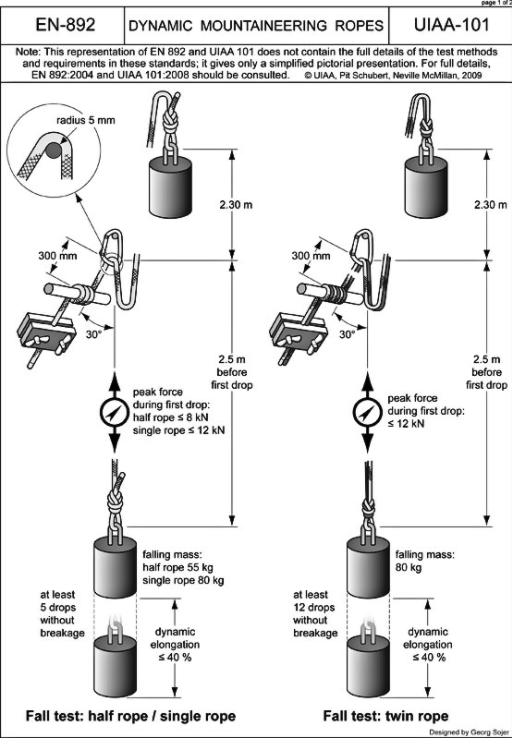
- Impact Force (kN) - Impact force measures how much force is transmitted to the climber during a fall. Generally, a lower impact force kN rating will indicate a softer catch and a more dynamic-feeling rope.
- Ecological - This category benchmarks any environmental considerations associated with a rope’s construction or manufacturing. There is currently no universal industry standard for this category, so we are simply highlighting any notable environmental initiatives or certifications associated with each rope.
Climbing Ropes Comparison
| Mammut Crag We Care Classic | Edelrid 9.8 Birdlime 1R | Sterling 9.6 VR96 | Sterling 9.4 IonR Xeros Dry BiColor | Edelrid Siskin Eco Dry | Mammut 8.0 Alpine Core Protect Dry | |
|---|---|---|---|---|---|---|
 |
 |
 |
 |
 |
 |
|
| UIAA Certified | Single | Single | Single | Single | Single, Half, Twin | Half, Twin |
| Why We Chose It | Outstanding value with minimal compromise. | Leading the way in sustainable rope design. | Workhorse durability with premium handling. | The one-rope quiver for all climbing styles. | Minimal weight, maximum performance. | Innovative cut-resistance technology. |
| Price | $229.95 – 60 m $269.95 – 70 m $309.95 – 80 m |
$299.95 – 70 m | $274.95 – 60 m $320.95 – 70 m |
$467.95 – 70 m | $379.95 – 60 m $419.95 – 70 m |
$299.95 – 60 m $349.95 – 70 m |
| Diameter | 9.5 mm | 9.8 mm | 9.6 mm | 9.4 mm | 8.6 mm | 8.0 mm |
| Weight | 58 g/m | 60 g/m | 61 g/m | 57 g/m | 48 g/m | 43 g/m |
| Dry Treatment | Non-Dry | Non-Dry | Non-Dry | Yes | Yes | Yes |
| Middle Marking | Mid-marker | Mid-marker | Mid-marker | BiColor | Mid-marker | Mid-marker |
| Static Elongation | 7.5% | 8.9% | 7.7% | 7.2% | 5.3% (single) | 9% (half) |
| Dynamic Elongation | 33% | 35% | 29.4% | 33.1% | 34% (single) | 30% (half) |
| Sheath Proportion | 42% | 41% | 34% | 39% | 38% | 36% |
| UIAA Fall Rating | 6 | 6 | 8 | 5 | 5 (single) | 5 (half) |
| Impact Force | 7.8 kN | 8.5 kN | 9.1 kN | 8.7 kN | 8.5 kN (single) | 6.4 kN (half) |
| Ecological | Sheath made of residual yarn. Bluesign® Materials. |
40% biobased polyamide renewable raw materials |
bluesign® material | bluesign® material | PFC-free coating | PFC-free coating |

Rope Summaries
Mammut Crag We Care Classic 9.5
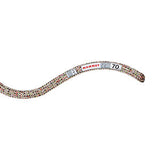
The Mammut Crag We Care Classic 9.5 takes a different approach to rope manufacturing by incorporating residual yarns left over from other production runs into the sheath. Rather than sending these materials to waste, Mammut gives them a second life, resulting in a rope where no two colour patterns are exactly alike. For climbers looking to reduce the environmental impact of their gear purchases, the Crag We Care is an easy choice.
What surprised us most is how little compromise comes with this approach. In the hand, the Crag We Care feels very similar to Mammut’s other 9.5 mm ropes, with a slightly firmer sheath and handling that inspires confidence day after day. As one of our most affordable ropes, it is an excellent choice for first-time rope buyers, everyday cragging, projecting, and gym sessions. It is even light enough to be a great multipitch rope. If you’re looking for the best value rope in the lineup, this is it.

Edelrid 9.8 Birdlime 1R
The Edelrid Birdlime 1R 9.8 represents a significant step forward in climbing rope manufacturing. As the world’s first synthetic climbing rope made partially from renewable bio-based raw materials, it demonstrates that environmentally responsible products do not need to come at the expense of performance. For climbers who place sustainability alongside durability and safety in their purchasing decisions, the Birdlime 1R is one of the most exciting ropes currently available.
In use, the Birdlime handles much like other Edelrid ropes, with a slightly firmer feel than some competitors but none of the cable-like handling often associated with durable ropes. What impressed us most is that, despite the innovative materials and manufacturing process, it performs exactly as a modern climbing rope should. Designed for everyday cragging, projecting, and gym use, the Birdlime occupies a unique place in our lineup as the most environmentally responsible rope we carry. The only real compromise is the lack of a dry-treated option, making it best suited to rock climbing during the drier months.

Sterling 9.6 VR96
The Sterling VR96 9.6 occupies a sweet spot between performance and value. Designed as an all-around climbing rope, it is equally at home projecting routes, top-roping, spending long days at the crag, or heading out on a multipitch climb. For climbers looking for a durable rope that can withstand plenty of falls without sacrificing handling, the VR96 is one of the standout options in this lineup.
What impressed us most is how closely the VR96 resembles Sterling’s premium Velocity 9.6 in the hand. Despite its more approachable price point, it handles like a much more expensive rope, with a supple feel that inspires confidence day after day. While not a UIAA Water Repellent-certified rope, the core does receive Sterling’s DryCore treatment. Beyond helping reduce moisture absorption, this treatment reduces friction between the rope’s internal fibres, helping extend its service life and maintain consistent performance over time. This makes it an excellent choice for climbers working difficult routes who want a rope that can take abuse while still feeling refined. The only real compromises are the lack of a full dry treatment and limited colour choices, but if those are not priorities, the VR96 offers some of the best value-to-performance we have seen in a 9.6 mm rope.

Sterling 9.4 IonR Xeros Dry BiColor
The Sterling 9.4 IonR XEROS Dry BiColor is the rope we would recommend to climbers looking for a single rope to do it all. At 9.4 mm, it strikes an excellent balance between durability, weight, and handling, making it equally suited to cragging, projecting, multipitch climbing, alpine rock, and ice climbing. Combined with a UIAA Water Repellent dry treatment, it is a rope that can confidently move between seasons and disciplines without feeling like a compromise in any one area.
In the hand, the IonR has a firm, tactile feel that makes clipping easy, while the smooth sheath feeds efficiently through protection and helps reduce rope drag. Like many dry-treated ropes, it can feel a little slick when new, but this quickly becomes familiar. What surprised us most was just how useful the BiColor pattern proved to be in practice. Unlike a traditional middle marker, the colour change remains visible throughout the life of the rope and provides an immediate reference point while managing rope at belay stations or during rappels. While it is more expensive than simpler ropes such as the VR96 or Crag We Care, the combination of dry treatment, BiColor construction, and all-around performance makes the IonR XEROS Dry BiColor one of the most versatile ropes in our lineup. For climbers looking for a premium rope that can handle almost anything, this is it.
For those who do not require the BiColor pattern, the 9.4 IonR XEROS is also available at a slightly lower price point.

Edelrid 8.6 Siskin Eco Dry
The Edelrid Siskin Eco Dry 8.6 is the performance-focused rope in this lineup. Designed for climbers who prioritize weight savings and efficient handling, it excels on long sport routes, demanding redpoint attempts, alpine rock climbs, and ice routes where every gram matters. At just 48 g/m, the Siskin is among the lightest single ropes currently available.
What surprised us most was just how noticeable the difference feels in use. Compared to a more traditional all-around rope such as the 57 g/m 9.4 IonR, a 70 m Siskin saves approximately 630 g, a difference that becomes surprisingly noticeable on long approaches and long pitches. The reduced weight makes clipping easier, particularly on long routes where the weight of the rope below you begins to add up. The Siskin is supple in the hand and handles exceptionally well. The tradeoff, as expected, is reduced durability compared to thicker ropes, making it less suited to heavy projecting or top-roping. However, its triple rating as a single, half, and twin rope adds a level of versatility. This is not a rope for everyone, but for climbers pushing their limits on hard sport routes, moving quickly in the alpine, or seeking a lightweight rope for ice climbing, the Siskin stands out as the highest-performance rope in our lineup.

Mammut 8.0 Alpine Core Protect Dry
The Mammut 8.0 Alpine Core Protect Dry is our preferred half rope for alpine rock and ice climbing.
What sets this rope apart is Mammut’s Core Protect technology. Introduced in 2025, Core Protect incorporates an additional aramid layer between the rope’s core and sheath, increasing resistance to cutting over sharp edges. While no climbing rope should ever be considered cut-proof, Core Protect provides an additional margin of safety for climbers operating in environments where sharp rock is unavoidable.
It is important to note that Core Protect is designed to improve resistance to cutting over sharp edges, not to general wear and abrasion. In other words, Core Protect helps protect against one of the most serious failure modes: being cut over a sharp edge. However, it does not make the rope more resistant to the day-to-day wear associated with regular climbing use.
What surprised us most is how little compromise comes with this additional protection. Despite the Core Protect construction, the Alpine Core Protect handles much like any other modern 8.0 mm rope, remaining supple and easy to manage. Compared to Mammut’s 7.5 mm half ropes, the larger diameter is noticeably less prone to tangling while also providing a welcome increase in resistance to day-to-day wear.
For climbers interested in a single rope with Core Protect technology, Mammut also offers the 9.5 Alpine Core Protect.


Leave a comment