





Alpine Shelter Guide
Match your shelter to your campsite
In the mountains, finding a flat place to sleep can be a luxury. The terrain you expect to camp in often dictates the shelter and setup you bring. A narrow ledge, a small rock outcrop, or a spacious alpine meadow can each require a very different setup.
Here are four camping configurations, from a bivy spot barely large enough to lie down on to a full expedition camp complete with sleeping zones and dedicated cook shelters.
Quick Comparison
| Setup | Best Terrain | Shelter Type | Lightest Setup |
|---|---|---|---|
| Ultimate Bivy | Tiny ledges, rock outcrops, fast alpine pushes | Bivy bag | Varies by kit |
| Minimal Alpine Tent | Snow platforms, ridgelines, small alpine camps | 2-person alpine tent | 2.54 kg / 5.6 lb |
| 3 Season Alpine Camp | Sub-alpine meadows, alpine lakes, established camps | Lightweight backpacking tent | 3.20 kg / 7.1 lb |
| Expedition Base Camp | Long-duration camps and weather-dependent objectives | 4-season expedition tent | 5.31 kg / 11.71 lb |
*Weights are based on the lightest listed configurations below where provided.
Setup 01
Ultimate Bivy
Sometimes the only flat spot is barely large enough to lie down. When the objective is climbing rather than camping, a bivy lets you stop almost anywhere without carrying the weight and bulk of a tent.

Recommended Kit
- Bivy BagSamaya Nano or OR Helium
- PadSea to Summit Ultralight XR or Therm-a-Rest NeoAir Xlite NXT
- Sleeping BagWestern Mountaineering SummerLite 0C or Western Mountaineering DreamLite +2C
- Optional ExtrasAdd a tarp for additional weather protection such as the Eagle Nest ProFLY Sil Tarp.
Setup 02
Minimal Alpine Tent
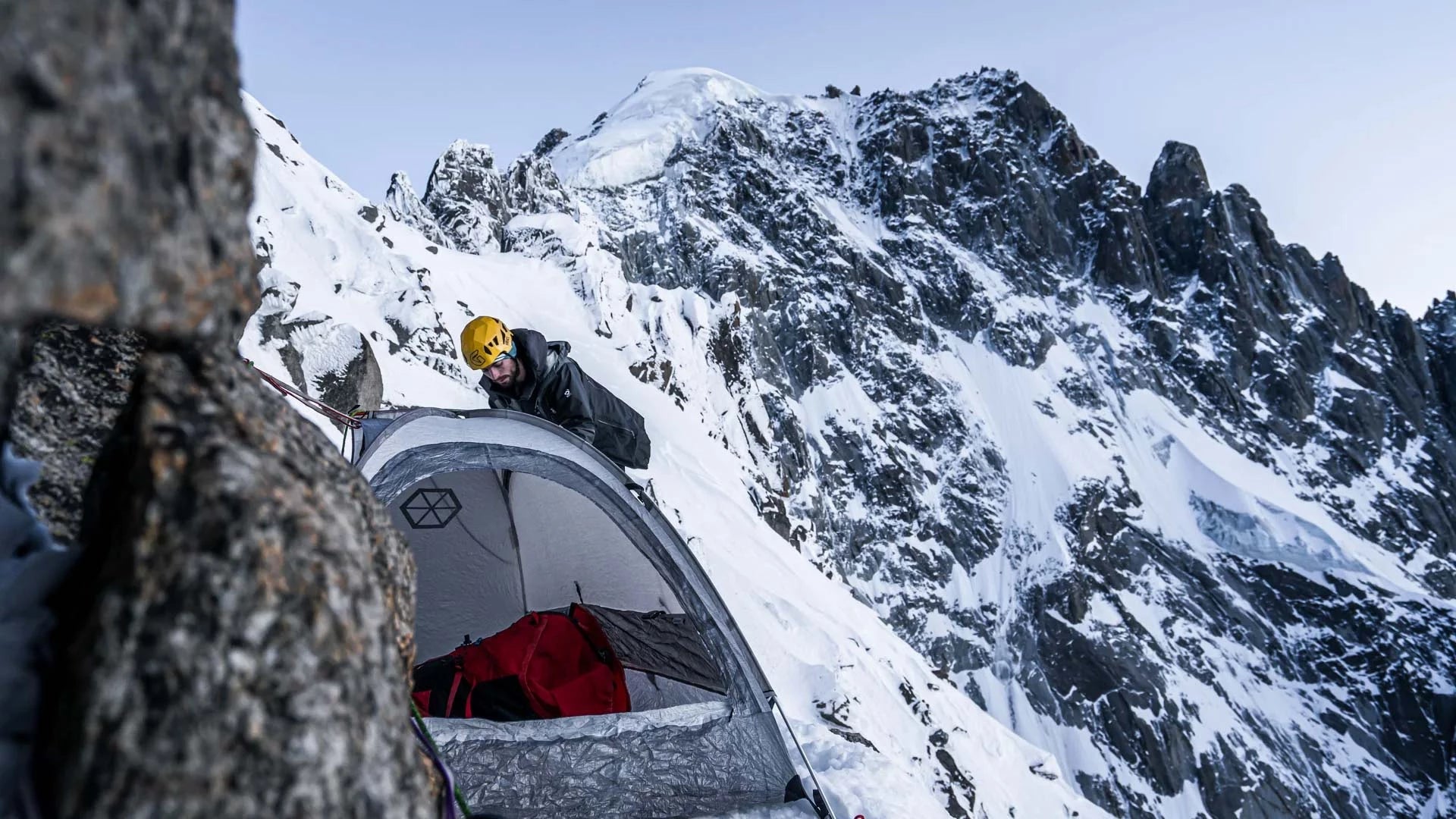
Steep ridgelines often have snow-covered breaks that can be cut into platforms, providing just enough room for a compact tent. This setup adds meaningful weather protection while keeping weight low enough for technical alpine objectives.

Recommended Kit
- TentSamaya Alpinist 2 Ultra Tent or Mountain Hardwear AC2 Tent
- PadSea to Summit Ether Light XR or Sea to Summit Pursuit Self-Inflating Sleeping Mat
- Sleeping BagMountain Hardwear Ghoul -7°C
- Optional ExtrasAC2 Footprint and AC2 Vestibule
Setup 03
3 Season Alpine Camp
When weight becomes less critical than comfort, a 3-season tent gives you room to spread out, recover, and enjoy evenings in the mountains between climbing days.

Recommended Kit
Setup 04
Expedition Base Camp
Built for extended stays where storms, changing weather, and multiple days in one location demand a shelter you can comfortably live in, not just sleep in.

Recommended Kit
- TentMSR Remote 3 or special order a dedicated base camp tent from any of the brands we carry.
- PadTherm-a-Rest NeoLoft paired with a Therm-a-Rest Z-Lite SOL
- Sleeping BagWestern Mountaineering Cloudlite -10°C or Mountain Hardwear Phantom -9°C
- Optional ExtrasSea to Summit Premium Pillow or Western Mountaineering Tioga Liner
Common Mistakes
Avoid These Common Mistakes
Most bad nights out aren’t really about “bad conditions”; they’re about small gear choices that don’t quite match the objective. Here are a few things we have learned over the years so you don't have to.
Bringing a sleeping bag that’s too warm
One of the most common mistakes. You end up sweating, then cooling off, and suddenly you’re colder at 2 a.m. than you should be. In the mountains, dry usually beats warm. Use extra layers that are removable, like thermals and fleece, to help regulate your temperature while not packing an extra heavy bag.
Underestimating pad insulation
A good sleeping bag won’t save you from a cold slab or snow if your pad isn’t up to it. Low R-value is one of the fastest ways to turn a decent night into a rough one. Add in an extra closed-cell foam pad to boost the R-value of a sleep system.
Buying a tent that’s too heavy
It’s easy to default to something bombproof, but you feel every extra gram on the approach. Most of the time, you don’t need more tent—you need the right tent, or even a bivy, for the terrain.
Buying a tent that’s too light
Lightweight tents are great for short, single push missions, but once you’re extending your stay beyond a few days, a more durable tent with added living space becomes valuable. Just like we mentioned above about choosing a tent that’s too heavy, you need the right tent for the job.
Forgetting ground protection
Easy to forget until something wears through or soaks out. A simple footprint or sheet of Tyvek is cheap insurance when you’re pitching on rocks or wet alpine ground.
Ignoring condensation
Even “dry” nights can soak out a shelter from the inside. Condensation comes from you breathing, temperature changes, and even cooking. If your setup doesn’t breathe, it’s slowly wetting out your sleep system while you’re trying to recover. Moisture builds up in sleeping bags and clothing, reducing loft and warmth, so dry things out and stay ventilated.
Need Help Choosing?
Build the right sleep system for your objective
Whether you're planning a fast-and-light alpine push, a weekend in the Bugaboos, or a full expedition base camp, our staff can help you choose a sleep system that matches your terrain, season, and objective.


Leave a comment